Tag: homeowners

  • Insurance Ineligible Risks and Pet Ownership, What Dog breeds matter?

    Insurance Ineligible Risks and Pet Ownership, What Dog breeds matter?

    Homeowners insurance continues on average to rise and the type of pets you own could be impacting your premium. Most common homeowners insurance policies will come with exclusions and a common one that gets a lot of attention is for the amount of dogs and type of dogs owned by the insured. Below is a list of dogs that insurance companies will typically adjust premiums for, exclusions for, or outright make an applicant ineligible.

    • Akita
    • American Bull Terrier
    • Staffordshire Bull Terrier
    • Chow Chow
    • Doberman Pinscher
    • Dogo Argentino
    • German Shepherd
    • Pit Bull
    • Presa Canario
    • Rottweiler
    • Wolf Hybrids
    • Husky
    • Mastiff
    • Any mix of the above breeds.

    Some of my smaller regional carriers won’t even consider a client if they own one of the dog types listed above. But it’s not always because of how dangerous or aggressive they are, so don’t take offense just yet. Let’s look at the Husky breed and why some insurance carriers are not interested in covering homes for people who have them as pets.

    Why is a Husky listed on the restricted breed or banned breed list?

    A Husky is not considered to be above average in regards to aggressiveness. However, they do have a very high ‘prey drive’ and this instinctual drive is why the Husky gets placed on the list. They are good at breaking out of fences and if they go out on the neighborhood and see a smaller breed dog, they immediately see them as prey. If the Husky were to attack the smaller dog, there is a potential for a property claim. Furthermore, even if the Husky didn’t chase after smaller pets, because they have a higher propensity to escape the back yard, they are more likely to get into the street and cause an accident.

    Are you looking for an insurance carrier that won’t exclude you for having a pet on this list? Well, I have options and would be happy to discuss your particular risk. Carrier options open up the more information I have like height of your fences, training, and history can go a long way to keeping your premiums in check. Give me, Chris Davidson, a call today to get started or text me at 812-489-0168.

  • Do I need an Umbrella?

    Do I need an Umbrella?

    Not just for a rainy day, a personal umbrella insurance policy is a tool to protect your assets from high liability claims. A personal umbrella policy, PUP or UMB, is recommended for almost any homeowner that owns a pool, trampoline, or have youthful drivers. In addition, if you have assets over your liability limit, it can be an inexpensive addition to your insurance tool belt.

    If you have home equity and a steady income, you should consider purchasing a Personal Umbrella Insurance Policy. If you have a youthful driver or pool, you absolutely should have a policy in place.

    What does an Umbrella policy cost?

    Most personal umbrellas start with $1 million in coverage and subject to underwriting, offer higher limits. Most policies for the first $1 million can be purchased for $250-500 per year.

    When would I use my Umbrella policy?

    An Umbrella is designed to set on top of your existing policy limits. Meaning, you couldn’t purchase an Umbrella policy only, instead you must have existing insurance policies in place. In addition, most Umbrellas will have requirements that dictate the limits of liability on your home and auto.

    For example, Auto-Owners will typically require $500,000 in homeowners liability and $500,000/$500,000/$100,000 liabilities on auto to be eligible for a mono-line umbrella policy. However, you can save on these underlying policies by bundling all insurance policies with Auto-Owners, which lowers the auto liability requirements to $250,000/500,000. It’s typical of other carriers to offer bundling discount and lower limit requirements as well.

    Based on the examples above, should there be a qualifying claim, payout would happen from your underlying policies first. In the example of your home, a $1 million dollar claim would first pull from your homeowners insurance, then an additional $500,000 from your umbrella policy.

    Without the umbrella policy in place, the client would be responsible for $500,000!

    What happens if I don’t have an umbrella and the claim exceeds my liability limits?

    Every state is different, but typically for every dollar over your insurance limits, you are personally responsible and your assets would be considered for payment. Its common for wages to be garnished and liens to be put on a personal home. A client wouldn’t necessariliy lose their house, but in case of the sale of the home the debt would be paid before proceeds would be paid out to the owner.

    How to buy an Umbrella?

    To get started, have your homeowners and auto declaration pages available. Also, have a list of any risks like number of vehicles, off road toys, boats, and other properties like rental and investment land. Then, give me a call to discuss appropriate limits and see if a monoline or bundled policy makes sense.

    I’m happy to advise on if an umbrella is appropriate for you. Give me a call anytime to get started.

  • What happened to Safeco Insurance?

    What happened to Safeco Insurance?

    Safeco is an insurance carrier which offered Homeowners, Auto, Renters, Pet, ATV Insurance and more. They were acquired in 2008 by Liberty Mutual, the LiMu Emu people. Effective 2026 the rebranding will be complete and SAFECO will now just be known as LIberty Mutual.

    Safeco didn’t go away, it simply had a rebrand with no other changes to the typical homeowner or auto insurance policy.

    If I sold you a Safeco policy, I’m still your agent! Nothing changes on your end other than some billing updates and logo changes on any policy paperwork you see. You won’t even need new auto id cards, same policy number and coverage. However, expect updated cards and documentation whenever your current policy renews.

    To recap, nothing is changing for our personal insurance customers, just the branding. Safeco operations and coverages have been owned by Liberty since 2008, so no changes to how you currently do business and purchase coverage.

    If you have any questions, feel free to give me a call.

  • What’s the best option on wind and hail claims, ACV or RC?

    What’s the best option on wind and hail claims, ACV or RC?

    ACV is actual cost value and means that in case of a claim the insurance carrier will payout based on a roof schedule or depreciated value, less your deductible. RC or replacement cost means the carrier will payout the total cost to replace your damaged roof, less your deductible. Which means, RC will almost always be a better option, when available. However, the up front premium cost may not be ideal, so lets look at some examples.

    The general trend is for homeowner insurance policies to only offer ACV on roofs once they get to 10 years old and some carriers even when they are only 5 years old. A newer roof generally means a lower deductible for replacement cost and a lower premium.

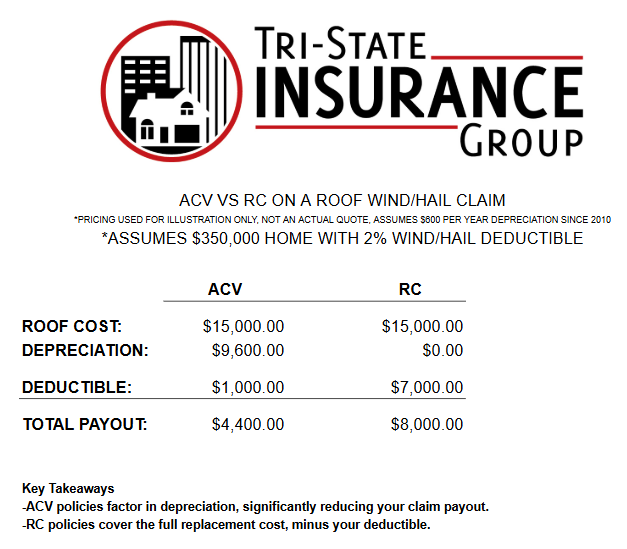
    In this example, lets assume we are insuring a home with a coverage limit of $350,000, which is the cost to rebuild the home as it stands now. The roof itself is an architectural shingle, installed in 2010 or 16 years old. To replace that same roof now would cost an estimated $15,000. Insurance carriers will typicaly depreciate the roof about $600 per year. One carrier is offering a low $1,000 deductible, but only ACV coverage on the roof, the other carrier is offering full replacement cost, but a much higher percentage based deductible of 2%. Let’s look at how this price breaks down, when it comes to claim time.

    Carrier 1 with a $1,000 deductible will depreciate the value of the roof by $600 per year or $9,600. Carrier 2 offering replacement cost won’t depreciate the replacement cost of the roof at all. Next we need to consider the deductibles, Carrier 1 is much lower at $1000 and Carrier 2 deductible will be $7,000 based on a 2% wind/hail claim deductible. This means that the total payout for Carrier 1 will be $4,400 and Carrier 2 will payout $8,000! That’s $3,600 more compensation with Carrier 2 by going with replacement cost coverage.

    Below is a graphic showing this math and how taking the higher wind and hail deductible can net you more compensation.

    As you can see, although the higher deductible seems like a bad decision up front, the older your roof is, the more savings a higher deductible can provide. It’s always important to review with your homeowners insurance agent, discuss the ages of your roof and expectation come claim time.

    Live in Indiana, Kentucky, or Illinois? If you do, give me a call or email, I’m happy to review or assist you in making the right decision when protecting your most valuable assets.

  • Homeowners Insurance, Should I pay in full?

    Homeowners Insurance, Should I pay in full?

    As premium rates rise, Evansville and Southern Indiana residents are looking for ways to save money. One way you can possibly squeeze a few more dollars out of your budget, is to pay your homeowners insurance policy in full. Although, not strictly limited to homeowners insurance, auto policies also benefit from paying the term in full.

    Yes, you should always pay your homeowners insurance in full.

    I realize not everyone has the financial fortitutde to pay a full term of insurance in one go. However, below are the benefits and long term savings you are potentially missing out on by using Escrow or paying monthly.

    Paying your homeowners insurance policy in full shows the carrier that you are financially responsible. Homeowners that show this type of planning are typically a lower risk. This type of customer, paying their bills in full and in advance are generally less likely to make friviulous claims. This ‘flag’ or signal to insurance carriers is then rewarded with lower premium rates.

    But what if you escrow your homeowners insurance premium?

    What is escrow and how does it affect your homeowners insurance premium? An escrow account is a dedicated financial “safety net” managed by your mortgage lender to ensure your home remains protected. Instead of you having to come up with a large lump sum for your homeowners insurance premium once a year, your lender divides that annual cost into twelve equal parts and adds it to your monthly mortgage payment. These funds sit in the escrow account until your insurance bill is due, at which point the lender pays the insurance company directly on your behalf. This “set it and forget it” system is designed to provide peace of mind, ensuring your coverage never lapses and your home stays shielded from the unexpected without the stress of a surprise annual bill.

    Most carriers are ok with your homeowners premium being paid by your mortgage company. Furthermore, some insurance companies will even extend the ‘paid in full’ or ‘PIF’ premium discount to those paid in escrow, but you should check to see if your payment method qualifies.

    A client of mine had their home insured through Auto-Owners and had the premium to be paid through escrow. With no other changes, other than switching their payment method to ‘in full’ saved them over $873 per year!

    If you are unsure if your policy qualifies for a paid-in-full discount, you should contact your agent. But, if you are interested in shopping homeowners insurance prices and learning about savings and coverage, give me a call today.

  • The Good News About Getting A New Roof

    The Good News About Getting A New Roof

    Typically homeowners aren’t excited about getting a new roof. It’s a large project, even if insurance is covering the majority of the cost you still have deductible, the mess, and the decision on what kind of roof to install? However, there is some good news when getting a new roof that you should keep in mind when the time comes.

    The type of roof matters, so for this article we will be discussing the best options in Southern Indiana and Tri-State area. So, for most residential applications, I recommend the Owens Corning Duration shingles. However, if your choices are between 3Tab Shingles or Dimensional/Architectural shingles, always go with the latter. 3 Tab shingles are a dated option and do not last as long as a good dimensional product.

    Once you deal with the headaches, clean up, and finding nails for the next few years, remember the biggest positive!

    Homeowners should see a decrease in premiums or increased coverage after installing a new roof. Typical insurance carriers will depreciate the payout on a roof claim, due to the age. This depreciation can start as soon as 6 years old, so it’s important to know what kind of coverage you have. Now that you have a new roof, full replacement cost coverage should be available.

    In addition, its possible your premiums should go down, as the risk for a claim has decreased with the installation of a new roof. So, when weighing the decision on whether or not to spend the money on replacing the entire roof or just repair, check with your insurance agent first. Your home may now qualify for deeper discounts or at least better coverage.

  • Is my roof damage covered?

    Is my roof damage covered?

    Does your homeowners insurance currently cover the cost of replacing your roof if it’s damaged? Insurance companies are changing what is and isn’t covered when it comes to roofs, which is one of the most common claims in southern Indiana. It is typical that your carrier will only cover ACV, have a higher deductible, or out right not cover roofing related claims.

    Our number 1 tip for buying new homeowners insurance is to make sure your carrier provides Replacement Cost coverage or RC on your roof. Replacement Cost coverage means that if you were to have a claim, requiring replacement of your roof, your insurance carrier will payout the full cost, less your deductible. If it just says ACV, that means that that total cost will be depreciated and you won’t be made whole.

    In addition, many carriers are changing the deductible from that of other perils. For example, it’s common to have a $1000 deductible for a tree falling on the home, but if you have a wind/hail claim it may be a percentage of your homes value. This would mean you would be out of pocket thousands of dollars if this small detail is missed.

    At Tri-State Insurance Group we only recommend carriers that offer full Replacement Cost on the roof, because we realize how important it is. In some cases, where we just can’t get a carrier to offer RC, we make sure and educate the customer. Remember, notify your agent if you have a new roof, it can change your out of pocket expenses when it comes to claim time.

    Common Carriers and Roof Replacement as of 10/13/2025

    Safeco – 20 year old roofs

    Madison Mutual – 15 year old roofs

    Pekin – 6 year old roofs

    Auto-Owners – 10 year old roofs

    Openly – 10 year old roofs

    CELINA – 10 year old roofs

    The trend is that carriers are no longer carrying full replacement cost on older roofs. Big box carriers have even sent out letters telling homeowners to replace their existing roof or be dropped from their policy. If you have any questions or want to get a quote for a carrier offering replacement cost coverage, then give me a call.

  • Homeowner Insurance Carriers

    Homeowner Insurance Carriers

    As an independent agent I am able to price check and shop the best carriers to fit your risk management needs. Below are just some of the carriers Tri-State Insurance Group sells every day.

    Safeco – https://www.safeco.com/

    Madison Mutual – https://www.madisonmutual.com/

    Pekin – https://www.pekininsurance.com/

    Auto – Owners – https://www.auto-owners.com/

    Openly – https://openly.com/

    Celina – https://www2.celinainsurance.com/

    This list is not exhaustive and each carrier offers it’s own benefits and appetite. Finding the right carrier, for your budget, and properly managing your risk is what we do. Give me a call today for a free consultation.

  • Maximize Protection, Minimize Cost: Smart Homeowners Insurance for Evansville

    Maximize Protection, Minimize Cost: Smart Homeowners Insurance for Evansville

    Protecting your financial future shouldn’t feel like a burden. That’s why myself and the team at Tri-State Insurance Group in Evansville, Indiana create smart policies tailored to each individual. The risk your home presents is molded by where you are in your life’s journey. This post will cover some of details to help you make a better decision on a new homeowners insurance policy.

    Your home is more than walls and a roof – it’s memories, safety, and dreams. Insurance ensures you never lose more than just things.

    And those things are replaceable with the right coverage. But you will most likely have more things to protect the older you get, starting a family, earning more in your career, paying for college, the list goes on. That’s why a homeowners policy for a home, doesn’t just go with the dwelling, a homeowners insurance policy should cover the things that matter to you.

    That’s why most major homeowner insurance companies recommend reviewing your policy every single year. Since covid, this is probably more important. We have seen home values increase in value faster than in years past. If your insurance hasn’t been reviewed for the past 5 years, its possible you don’t have enough coverage. A home that cost $170,000 to purchase 5 years ago, might take $300,000 to rebuild at todays prices. A smart policy will get reviewed and updated if required every year.

    How about liabilities? Fresh out of college you don’t have a lot to protect, yet. However, down the line as your wealth grows and you accumulate stuff, the cost to replace and protect all those items increases. Yet another reason to keep that policy updated and have the backing to cover those unexpected exposures.

    None of the increases in coverage and homeowner insurance policy reviews matter if it’s not affordable. We know it has to make financial sense, which I take the time to ask the questions, review options, and shop carriers that are interested in your business. Along the way I can help look out for the pitfalls and gaps that would make a bad experience worse.

    Give me a call, Chris Davidson at 812-475-9595 extension 113 to get started. If I’m your agent, you know the policy is on the house!

  • Earthquake Coverage for Southern Indiana

    Earthquake Coverage for Southern Indiana

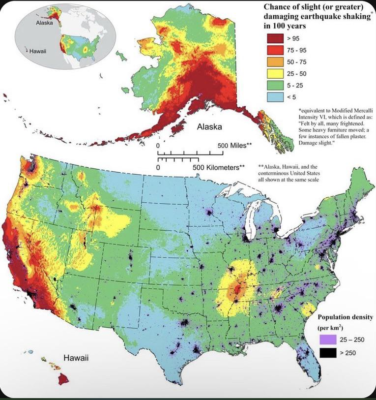
    If you own a home in Evansville, you should have earthquake coverage. Adding an earthquake endorsement to a homeowners policy is inexpensive and a great way to manage the risks of living in Southern Indiana.

    Your home is not covered in case of an earthquake, unless it specifically states it on your policy.

    When choosing Earthquake coverage, it’s important to understand what the costs are. Like most insurance policies, it’s not just the up front premium, but also the deductible that can make a difference. The team at Tri-State Insurance Group offer earthquake insurance with deductibles as low as 2.5%, one of the lowest deductibles in the nation. Most earthquake deductibles range from 5%-25%.

    We don’t have frequent earthquakes in southern Indiana, but we do live in the danger zone. Evansville is located at the northern edge of the New Madrid Fault Line, which is responsible for the largest earthquake in North America. Be prepared, cover the risk, and get Earthquake insurance today.